Don’t be lame

One moment, I was walking down the jetway in Chicago, lost in thought. Screen Shot 2014-02-11 at 11.10.31 PM The next moment, I was on the floor, sprawled on a rubber mat that was covering an irregular surface of the ramp. Unfortunately, the rubber mat had gotten wet and my boot had slid on it, bending my foot underneath me. After I clumsily retrieved my bags, I got up and limped along with a broken toe, a torn boot, and a bruised hip – and a lot of anger as well. “They should have covered the floor with something less slippery!” I thought, remaining angry through the flight. It took a while before I remembered a corny, but very smart, wordplay that Michael Brown offers us in The Presence Process.

“To blame is to…be lame.”

Brown explains that when we blame others, we disempower ourselves, accepting that we are a victim and the “powerless prey of others.” I had to admit that Brown was right, as I clearly felt like a victim who had no part in causing the accident.
He goes on to say that when we blame others, we frequently react in ways that later make us feel guilt, regret or shame. Check, on this point too. After later chastising an airline employee for the irresponsible placement of the rubber mat, I regretted what I had said. This man had no part in the event and didn’t deserve to be treated badly. And continuing to blame someone else would have distracted me from placing greater attention on where I stepped, as I negotiated more wet and icy walkways. On the other hand, realizing that only I could keep myself safe gave me a sense of responsibility and powerfulness as I continued my trip through the frigid, snowy Midwest.
Knowing that the only person we really have any control over is ourself, it makes sense to stop blaming and reclaim our responsibility to make a difference in our daily lives. I can guarantee that it feels a lot more powerful. And living with less of the resulting guilt, regret, and shame sounds like a terrific way to make our lives feel less stressful and more joyful. Although I’m still limping, a broken toe seems like a pretty small price to pay for this important lesson.


Posted in mindfulness, physician coach, physician coaching, physician communication | Tagged , , | Leave a comment

Focus on the spaces

Yesterday, my husband took a ski lesson.  A very experienced skier, he decided to work on some advanced skills.  After skiing over moguls (big bumps of snow that really test your courage and skill – one local magazine commented, “it’s not that you can’t ski bumps, it’s that you can’t ski, and the bumps show it.”) they moved on to skiing in and out of trees, some of which were pretty close together.  Skiing even close to trees causes every muscle in my body to tighten up, as I immediately imagine crashing right into the trees.  As a matter of fact, all I can see are those trees.  But as the instructor wisely suggested, “focus on the spaces between the trees – not on the trees themselves.”

Screen Shot 2014-01-26 at 9.13.49 PMIt reminded me of a time many years ago when I was riding bikes with our family. I can still feel my panic as I saw only a very narrow space between two trees in front of me.  Our son told me that if I kept my eyes focused on the path  I wanted the tires to go on, the bike would naturally go there.  As he rode on ahead of me, he turned around and shouted, “Conquer your fears!”  So I did what he suggested, and was amazed when I rode right between the trees, and not into them as I had feared.

How many times do we focus on the trees – the obstacles in our way – rather than on the goals we are working towards?  We’re sure  someone will say no, or we won’t have the time or the skills to make it happen, or it will cost too much. We defeat ourselves before we even begin.   We let the obstacles look so big and scary that we miss the spaces, those opportunities for us to find our way through the trees. But when we keep our goal in sight and continue to be connected to our passion for that goal,  the spaces are easier to see – whether it’s the path we intended to take, or another one that opens in front of us.

What goal do you want to reach?  Why is it important for you to reach it?  Without focusing on why or how it might NOT happen, tell me about the space that will allow you to reach that goal…and then take your first step.  Don’t be too surprised when you see the path open up in front of you.

Posted in physician coach, physician coaching, physician fulfillment, physician work life balance | Tagged , , , , | 2 Comments

Being Persona Non Grata

Last week, I was a patient.  I was brought to an exam room and interviewed by a friendly nurse with a great bedside manner.  She introduced herself, showed her human side, and then left me alone in the room, with the door slightly ajar.  Shortly after that, another medical staff person entered the room and walked straight to the computer monitor before she realized that I was sitting in the room.  “Oh, I didn’t think anyone was in here!” she exclaimed, and then quickly left the room.  What I felt was a sense of invisibility – I was sitting in a room, but certainly was not a person of any importance.  I winced, mostly because I realize that I do the same thing.

There are times when I mistakenly enter an exam room, thinking that my patient is waiting inside, only to find a patient I don’t recognize who is waiting for another provider.  I quickly apologize and leave the room, sorry to have “bothered” the waiting patient.  In truth, I am the one who is bothered. I have a busy schedule and the person I was expecting isn’t where I expected them to be.  As I know now, the patient in the room is most likely left feeling confused and somehow “wrong.”  How much better would they feel if, instead, I apologized and took the opportunity to ask them if they were comfortable, or if I could get them anything while they waited?

As we rush through our frequently over-scheduled days, it’s easy to forget these simple human touches.  But each time we can bring ourselves to see the person in front of us and respond in a kind and thoughtful way, we have an opportunity to forge a meaningful connection that enhances our patient’s experience and our own personal satisfaction.

Posted in building relationship with patients, effective communication in healthcare, first impressions, physician coach, physician coaching, physician communication | Tagged , , | Leave a comment

It’s always a choice

People often remark about my grey hair.  Some of the comments are very funny.  A young man working at the 7/11 told me he liked my hair, adding, “yeah, I’m a Raiders’ fan.” (The Oakland Raiders’ team colors are silver and black, for all the non-NFL fans reading this.) Other comments are less amusing, like the colleague who advised me that I “would look much younger” if I dyed my hair.   Many women lament the fact that they dye their hair and state that if they had shiny hair like mine, they would let it become grey.  What they don’t know is that I would have chosen to leave my hair grey no matter what it looked like.

That choice was made the first and only day I colored my hair, wincing each time the hairstylist poked my scalp with a crochet hook to pull strands of hair through small holes in a plastic cap on my head.  I chose whatever my hair was going to look like over adding another appointment, an unpleasant one at that, to my schedule.  Having brown hair was not enough of an incentive to drive to the hairdresser’s,  spend 2-3 hours there, and put up with the discomfort every 4-6 weeks.

Screen Shot 2014-01-19 at 11.36.10 PM

Each time we do or don’t do something, we are making a choice.  If we choose to stay at work and finish our charting, we are saying “yes” to the satisfaction we get when we complete our work, while saying “no” to attending our child’s basketball game.  Although we might feel as if we have no choice, we have, in fact, chosen.

Is there a way to “have our cake and eat it, too?” Certainly not in the moment (although I tried for years to be in two places at once).  But if we look at our values and see that our need to provide excellent care (and thus to complete our charts in a timely manner) is in conflict with our desire to support and be involved in the life of our child, we can creatively plan how we want to respond.  We might explain to our child that we will be there, although late, and affirm our love and our interest in his or her life.  We can make other plans to spend some special time with our child. We can complete our charts later that night, if that is a possibility. What is important is that we acknowledge that we are, always, making choices. And that we make sure that those choices align with our true values.

Many healthcare professionals, having chosen a career of service, are people pleasers.  This can make it difficult to say “no,” even when we want to.  But knowing what we’re saying “yes” to can make it easier to refuse an offer or a job.  A new role, even one that interests you, is easier to decline if you know that you’re saying “yes” to spending more time with your spouse, children, or another important activity.

What choices do you want to be making?

Posted in mindfulness, physician coach, physician coaching, physician communication, physician work life balance | Tagged , , , | Leave a comment

Got community?

There I sat, waiting to have my blood drawn.  Sitting with me were a young boy with his mom, an elderly woman in a wheelchair accompanied by her daughter, a preteen girl sharing a seat with her mother, and many others.  We were all there for the same purpose but were in our own worlds, isolated from each other. As for me, I was absorbed in my book, pretending that I was alone.  But just then, an elderly man sat down.  He immediately began talking to the couple next to him, who smiled politely but didn’t really engage.  Undeterred, the man asked the young boy sitting with his mother, “Do you know what one eye said to the other eye?”  The boy looked at him blankly but this didn’t stop the man, who was intent on connecting.  “There’s something that smells between us!”  The man beamed as a smile came to the boy’s face. Gleefully, the man continued on his happiness spree.  “Did you hear about the drunk crocodile that couldn’t use a phone?” he asked the woman in the wheelchair.  “He was too crocked to dial!” he continued.  At this point, we were all smiling and looking at each other warmly.  The boy then repeated the joke about the two eyes to the woman in the wheelchair.  A community was born.

To us, our offices, clinics and hospitals are home turf.  We feel comfortable there, enjoy the security of our friends and colleagues, and have a job to do.  Our patients, on the other hand, frequently feel out of place, worried, and isolated.  So how can we help them build community, or at least feel more comfortable, in our waiting rooms and healthcare spaces?

Many offices have snacks, or at least coffee, tea, or water for patients to drink while they are waiting.  Patients definitely appreciate this gesture.  In our office, I notice  conversations between patients in the waiting room that begin over the selection of tea.

Other offices play videos that can serve as a point of communal conversation.  Talented receptionists know how to warmly greet patients so they feel welcome.  In a small office, receptionists can help patients engage with each other by raising interesting topics for discussion.  We can even consider wackier ideas, such as posting a riddle or trivia question each day – patients come to look forward to this tradition in an office and often strike up conversations about the answers with other patients waiting with them.  In any office, it is crucial to let our receptionists know that making our patients feel welcome is an important part of their job if we want this to occur.  Even the simple gesture of saying, “Welcome!” to every patient as they check in makes a difference.

As we are asked to pay more attention to patient satisfaction scores, most of which focus on aspects of the patient visit that are not under our control, we are wise to find simple ideas that contribute to a better experience for our patients.  Making our waiting area a warmer, friendlier place is one easy way to improve our patients’ encounter, and that translates into a better experience for us, as well.

Posted in building relationship with patients, physician coach, physician coaching, physician communication, physician fulfillment | Tagged , | Leave a comment

2014 – Make Way for the “Bad”

Last night I attended an annual holiday party, intent on being the best receiver I could be. (Please see my previous post!)  This party is one of those events where you see people you haven’t seen since last year’s party.  The experience reminds me of seeing a small child who you haven’t seen for several months – the changes in people are often dramatic.  Although I had many interesting conversations, two stood out –  for the same reason.

Screen Shot 2013-12-30 at 7.17.16 PM

The first was with a lovely woman I’ve known for many years.  Our kids went to school together and we saw each other many times.  But this time, she was different – there was a depth and an aliveness  I hadn’t noticed before.  When I shared that perception with her, she told me that as a result of a painful divorce, she had been forced to become more independent. Now single, she had learned about and taken over her finances so she felt knowledgeable and in control,  moved into and redesigned a living space that suited her, and nurtured even closer relationships with her children that brought her great happiness.  Although she initially felt the divorce was the worst thing that could happen, she now understood that it was this event that had prompted her to grow, develop as a person, and lay the foundation for the wonderful relationships she was enjoying.

A second person shared that because of a tragic experience, her husband was now working throughout the world, bringing better medical care to underserved areas. Although his former practice was very successful, he was now involved in work that was much more fulfilling and he was making a difference in the lives of so many people. Again, without the preceding difficult situation, he would never have expanded his life in this way.

We all tend to label some things  “good” and other things “bad.”  But do we ever really know?  So often things that are “bad” lead to the best things in life.

In the words of the Palestinian poet, Naomi Shihab Nye,

“Before you know what kindness really is you must lose things…Before you know kindness as the deepest thing inside, you must know sorrow as the other deepest thing.”

Learning from  difficult situations takes a willingness to be vulnerable enough to acknowledge that things haven’t gone the way we wanted, an openness to the possibility of a new path, and courage to take our first steps.  Often, our new path isn’t initially clear and our first steps can be terrifying, like walking into a thick fog where our next step could take us off a cliff.  But as we take those steps and feel our way, we often find ourselves in a much better place than the one we left.

So my hope for all of us is that, as 2014 brings the difficulties that it will, we find the support we need to be vulnerable, open and courageous to create a life that is fulfilling and that reflects who we are as unique, precious individuals. 

Posted in mindfulness, physician coach, physician coaching, physician fulfillment, physician work life balance | Tagged , , , | Leave a comment

Being the best receiver during this season of giving

The holiday season is here!  Lights are sparkling, people are partying, and stores are selling.  It can be so overwhelming!  Running from place to place, worrying about the perfect gift for each person on our list, and for some of us, squeezing in all the patients who want to be seen before the end of the year makes for a pretty stressful time.  If we look around us, we see that most of our colleagues and friends are feeling the stress, too.

So how do we navigate this busy time so we can  enjoy the company of those we’re with and nurture ourselves in the midst of the overwhelm?

Screen Shot 2013-12-18 at 5.59.51 PM

We can actually find a great idea in a very unlikely place. Peter Bregman, a management and leadership consultant, shares some sage advice, even though the connection to the holidays may not be immediately obvious. http://peterbregman.com/articles/the-most-overlooked-leadership-skill/  Just as a good quarterback is only as effective as his receivers, Bregman argues that leaders must not only be effective at sharing their vision and ideas, they must also be good receivers. They must be able to listen well and be open to the ideas and concerns of those they work with.  Similarly, as we meet old friends, colleagues or new acquaintances at our many holiday celebrations, we can be good receivers for each of them.  How do we do that?  By inquiring about their lives and concerns and listening beneath the words for the emotion or need that they are expressing.  Bregman encourages us to do three things as we listen: be courageous, don’t judge, and stay open.

It takes courage to really listen to what people are saying – after all, they may express ideas that we disagree with or find uncomfortable.  It’s a human tendency to judge – our species wouldn’t have survived if we didn’t reflexively judge what seems safe vs.  dangerous, or what we like vs. what might be unpleasant.  In medicine, we constantly judge our patients, our colleagues, and ourselves in order to determine the proper diagnosis and treatment and continue to improve our skills.  But when we judge, we actually limit our listening ability.  We don’t fully take in what the person is telling us.  So by refraining from judging (which takes practice and discipline!) we keep ourselves open to truly hearing what the other person is saying.  We can paraphrase what we heard to make sure we have it right.  We can ask why they might have adopted a particular perspective.  All with the intent of staying open so we can understand and connect with the other person.  Those individual experiences of connection nurture our sense of being human and give our lives greater meaning.

So during this holiday season, let’s enter each room with the feeling that our arms are wide open – to receive each person we meet.  The experience might just be the best gift we give, and the best one we receive.

If you like this post, please forward it to your friends and colleagues!

Posted in mindfulness, physician coach, physician coaching, physician communication, physician fulfillment | Tagged , | 1 Comment

Slow down for life’s subtle riches

Screen Shot 2013-11-09 at 1.35.04 PMIt’s been shown that mindfulness training or exposure protects against burnout, diminishes the intensity of chronic pain and generally increases our happiness.  We introduced a mindfulness exercise to the 2nd year medical students this week in the hope of giving them a tool to achieve these goals.  It was the well known activity of taking a raisin and really experiencing it – the sound of it being squished between our fingers, its smell, texture, and taste.  Our only problem is that we didn’t have any raisins.  Fortunately, I had a bag of Marcona almonds, fried with rosemary and salt – we could use those instead!

The almonds have a lot of texture, and one student admired  the shininess of the oil as it reflected off the ridges on the nut.  Other students found that the scent of rosemary took them back to camping trips they had enjoyed. What struck me was that when I put the nut in my mouth, I was immediately hit with a burst of flavor – oil, salt and rosemary…delicious!

And then came the letdown.

The almond was completely tasteless as it sat, whole,  in my mouth.

I have to admit that I was disappointed – and bored.  I might have spit the almond out, if the instructions hadn’t then said to bite into it.  So I bit into the almond and chewed it slowly.  A subtle, nutty flavor filled my mouth – an understated but truly enjoyable flavor that I had to be quiet and mindful to even notice.  If the salt and rosemary hadn’t already washed away, I would never have noticed it.

As we all lament, we live in a culture of quickly changing sensory experiences – beginning with Sesame Street when we’re children and continuing into video games and fast-paced action movies.  This reliance on constant stimulation has made us  jaded and dulled our ability or willingness to notice the subtle experiences of our lives.  Because we expect to have something immediately grab our interest, we give up on people or experiences because we judge them not to be worth our time, even before we see what’s inside.

I’m going to take a moment or two today to slow down and notice the subtleties of my life.  I hope you’ll do the same.   Really notice the feel of the breeze in your hair, the warmth of the sun on your face, the feel of your sweetheart’s hand in yours, the smile of the person sitting across from you.  I have a hunch that our lives will seem happier and richer because we’re taking the time to truly be in its experience.  Let me know what you notice, ok?

Posted in mindfulness, physician coach, physician coaching, physician fulfillment | Tagged | 1 Comment

The Elephant in the Room – How to make friends with the monitor in your exam room

Elephant in roomAt a recent doctor’s appointment, I was ushered into the exam room by an assistant. She never introduced herself and spent our entire time together with her back to me, facing a computer screen. As you can imagine, the interaction was far from the warm and welcoming “patient-centered” medical care that is now advocated. While she could easily have introduced herself and created a human-to-human moment, the presence of the computer creates challenges that are more complicated to deal with. No one likes the computer in the room. Our patients don’t like it, and neither do most of us. It adds to our workload, gets in the way of direct communication with our patients, and creates the impression in the minds of our patients that we aren’t listening to them.

But as much as we don’t like it, EHRs are here to stay. So what are we to do?

We can begin by being transparent with our feelings. We can let our patient know that we, too, are frustrated with our need to look at the computer, instead of at him. And then we can reassure him that we are, in fact, listening.

We can also use the computer in a more transparent way. Tell your patient what you’re doing, whether it’s entering his history, checking his meds, or looking over the note from a recent referral. That keeps him involved in the visit, rather than making him feel that you’re more involved with the computer than with him. Periodically, we can paraphrase what we just entered into his record. We’ll make sure that we’ve gotten his history right and also make the point that we are listening.

Situating the computer so we can face the monitor and our patient at the same time is wise. Sometimes it’s just not possible to do that, but every effort should be made to arrange the room so our patients are not staring at our back.

When there are functions of the EMR that can be shared – looking over the trends in lab data, for instance – we can show the monitor to our patient, so he understands that there is a benefit to this new occupant of the medical space.

And we need to be aware of those times when our eyes must be on our patient. If we want our patient to remember something we are saying, when we are telling him something serious or difficult, or when our patient is sharing something emotional, we absolutely need to make eye contact. Especially if we have just spent some time looking at the computer screen, our patient will notice this shift. He will sense the extra attention we are giving to the interaction and understand that, although we do spend more time looking away from him, we are listening and are there with him when he needs us.

For other suggestions regarding how best to incorporate the EHR into your patient visit, check out this post:

Posted in building relationship with patients, effective communication in healthcare, first impressions, physician coach, physician coaching, physician communication | Tagged | Leave a comment

Let’s Talk about Failure

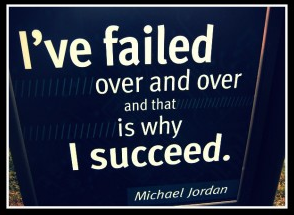
Screen Shot 2013-11-03 at 4.38.43 PMUgh…even the possibility of failing makes most of us cringe. We are supposed to be smart, fearless, skillful at EVERYTHING we do and many things we don’t do, visionary…the list goes on and on, doesn’t it?
In other words, we are supposed to be perfect!

Wow, what a trap that is.

When we focus on being perfect, we deny ourselves opportunities to try things that might be useful, fun, or help us grow.
Malcolm Gladwell tells us that to become competent at a new skill we need approximately 10,000 hours of practice – and most of our early results won’t be pretty. Most authors know they will receive many rejections before someone will agree to publish their book. So each rejection is a stepping stone that brings them closer to the “yes” they are seeking.
Some “failures” don’t even reflect our skills or effort. Job promotions, hirings, elections, and admissions are often based on factors that are not under our control and may even be somewhat arbitrary. That doesn’t keep us from feeling like a failure when we are not chosen.

It seems that failure is just going to be a part of our lives. The fear of failing keeps us from doing many things that we would like to try. So is there a way to look at failures that takes the sting out of them and gives us more freedom in our lives?

Laura Wallendal, COO of EdTrips, suggests that we brag about our failures, as we would about our successes. She feels that, “It shows confidence and suggests that you’re solving difficult problems, and that leads people to help in ways they otherwise wouldn’t.”

Although many coaches stress the “gift” in each failure, seeing the benefit of failing may be pretty difficult as we look through the mud we have fallen in or the egg on our face. Surprisingly, the best thing to do from the start is to really feel that mud or the egg on our face. What do we notice when we allow ourselves some time to be in the experience of the “failure,” rather than trying not to feel any of it? Does our chest get tight? Do we feel as if we’re made of stone? Does it seem as if we’re locked in a dungeon? By allowing ourselves to feel what we feel, knowing that it is just an experience that, like all other experiences, will pass, we usually find that the sensation or imagery shifts. The tightness eases up. Our body begins to feel movable again. The dungeon might morph into a tunnel with a light at the end. Just being with our experience allows our inner strengths to show us that our experience is just a temporary feeling and that there are other ways to see this.

Similarly, we can play with the perspective we have taken – was it a failure, or was it an experiment that yielded an unexpected result? As Thomas Edison said in inventing the lightbulb, “I have not failed. I’ve just found 10,000 ways that won’t work.” There are many creative ways to change our perspective, from looking at the situation from the point of view of someone we admire (Mother Theresa, Nelson Mandela, etc.) to taking on the perspective of an animal. How would your family dog look at this “failure?” How about a great white shark? One of my favorite perspectives is that of a child – children fail at most things they initially try, yet they keep trying because the goal is just so enticing. None of us would be walking if we had given up after just one failure! After exploring a few other perspectives, we can ask ourselves what we have learned about this “failure” and how we want to proceed.

In the words of Winston Churchill, “Success is walking from failure to failure with no loss of enthusiasm.”

Even though the outcome wasn’t what we had hoped for, there was a reason why we tried what we tried. There was a project we wanted to complete, a connection with a person we wanted to establish, a new process we wanted to introduce. Armed with a new, more empowering perspective and the learning from our last “experiment,” we can move forward and try again. It might be toward another “failure” or toward a result that we might define as “success.” Either way, we will be learning, growing, and giving others permission to try as well. The world can’t help but be better because of our courage and vision.

Posted in effective communication in healthcare, honesty in medical care, mindfulness, physician coach, physician coaching, physician communication, physician fulfillment, physician work life balance | Tagged | Leave a comment